Blog
What is the best paint for exterior facades?
· 5 min read · H.M. Pinturas
What is the best paint for exterior facades? The one that suits the wall: the type of render, the condition of the facade and its exposure to sun and sea air matter more than the brand. In this guide we explain the three types of exterior paint, how to read a technical datasheet and what changes in the Algarve climate.
What is the best paint for exterior facades?
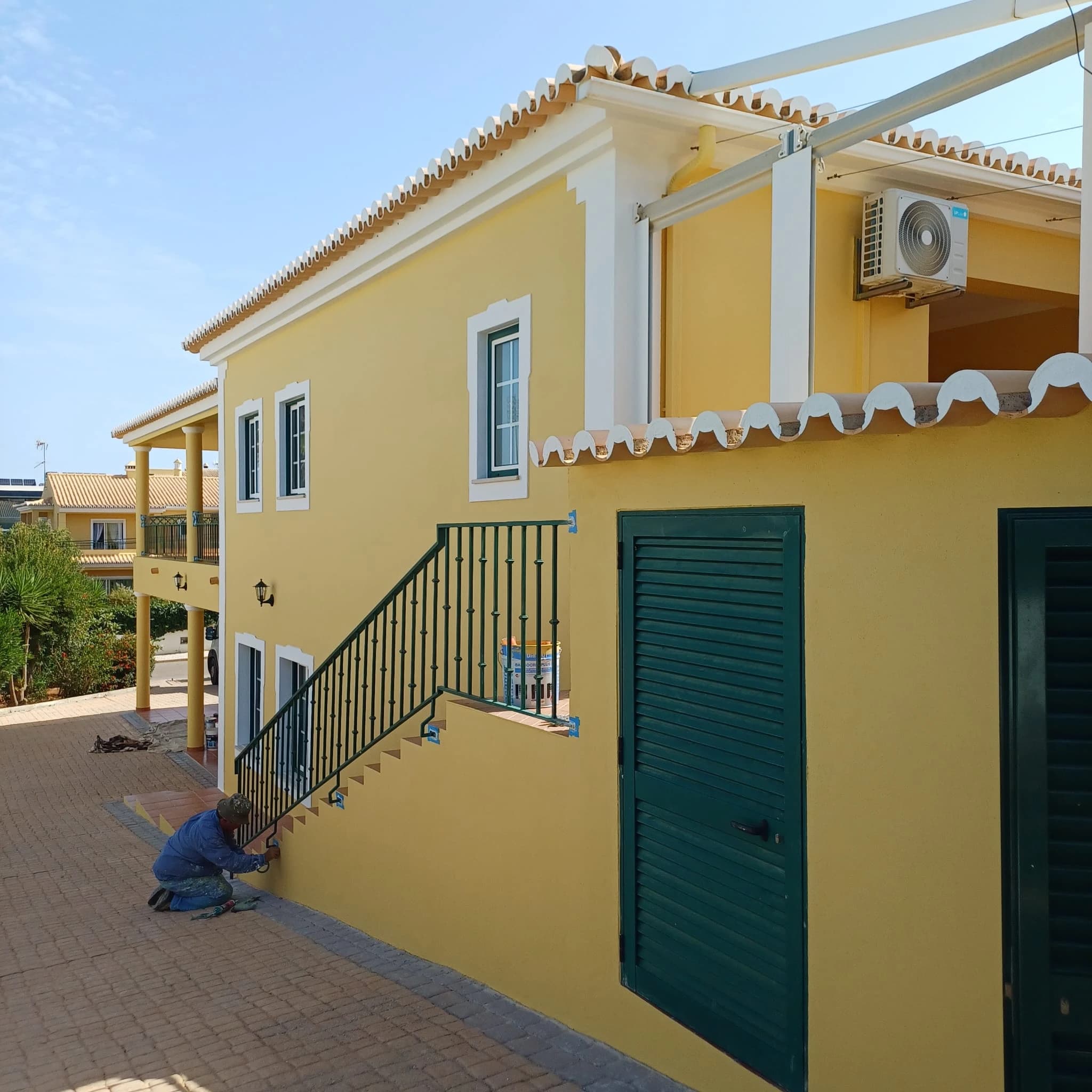
There is no single best paint for every facade: on most houses with cement render, the right choice is a high-performance acrylic or siloxane paint, protected against fungi and algae, applied over a primer. On old buildings with lime render, we choose mineral or siloxane paints that let the wall breathe.
We work with brands such as CIN, Robbialac, Barbot and Titan and choose the product for each surface after seeing the facade. The examples in this guide come from the technical datasheets published by the manufacturers.
What types of exterior facade paint are there?
Exterior facade paints fall into three families: acrylic, siloxane and mineral silicate. They differ mainly in the binder, in how much water vapour they let out of the wall and in how much rainwater they let in.
| Type | Example (datasheet) | Water vapour (V) | Liquid water (W) | Suited to |
|---|---|---|---|---|
| Acrylic | Barbot Silicor, styrene-acrylic binder | V2, medium | W3, low | New cement render or facades being renewed |
| Siloxane | Robbialac Siloxan NG | V1, high | W3, low | Recent and old buildings, stone, render |
| Silicate (mineral) | Robbialac Visolsilica RS | V1, high | W2, medium | Cement or lime render, historic buildings |
- Acrylic. Barbot Silicor is a textured water-based facade paint, with a film protected against fungi and algae that can hide imperfections in the render.
- Siloxane. On Robbialac Siloxan NG, water is not absorbed: it forms beads that run off and leave the surface clean and dry (the lotus effect).
- Silicate. Robbialac Visolsilica RS is a mineral potassium silicate coating with a natural look, typical of old facades.
What do the V and W classes on the datasheet mean?
The V class shows how much water vapour the paint lets out of the wall, and the W class how much liquid water it lets in. For a facade, the ideal is low water absorption (W3) with medium or high vapour permeability (V2 or V1), so the wall is protected from rain and can still dry out.
Both classes appear on the datasheet of any serious facade paint. The Siloxan NG datasheet, for example, states vapour permeability V1 (high) and water permeability W3 (low). Asking the painter for the datasheet is the simplest way to compare quotes.
Why does the Algarve climate demand more from paint?
Because the facade spends much of the year in sun and heat, and near the sea it also takes the sea air. In Faro, the maximum temperature reaches 25 °C or more on about 115 days a year and 30 °C or more on about 35 days, according to the IPMA 1991–2020 climate normal.
Sun, sea air and winter rain wear down exterior paintwork. Peeling, blistering, fading or cracks are signs that the protection of the facade is failing and that water will start getting in. That is why, in the Algarve, it is worth choosing a high-performance paint with water-repellent and anti-fungal additives rather than the cheapest option.
Which paint should be used on old buildings?
On old lime, stone or brick walls, use mineral silicate or siloxane paints with high vapour permeability, which let the wall breathe. Before choosing, check on the datasheet which surfaces the paint can be applied to.
Siloxan NG was developed for the renovation and restoration of historic or old buildings. Visolsilica RS, on the other hand, must not be applied over gypsum or over conventional (plastic or solvent-based) paints: on a facade already painted with acrylic paint, choosing a mineral paint means removing the old paintwork. On heritage work, such as the restoration of the Parish Church of Alcantarilha in Silves, we take extra care.
Does paint solve damp and mould on the facade?
A good exterior paint prevents water absorption and the growth of mould and algae, but it does not fix a leak. If the damp comes from structural leaks or rising damp, a repair or ETICS insulation may be needed first.
On a facade that already has fungi and algae, the Barbot datasheet says to wash and disinfect the surface and treat it as a new paint job, reinforcing the paint with an anti-fungal additive in the most exposed areas. Painting over mould without treating it does not solve the problem. For mould indoors, see the guide on mould and damp on walls.
How long does exterior painting last?
With high-performance acrylic or mineral primers and paints, exterior painting lasts between 8 and 15 years. The exact figure depends on the condition of the facade, the preparation and the exposure to sun and sea air.
That is the durability we state for our exterior and facade painting service, and all our work has a 5-year guarantee against application or material defects.
Why does preparation matter as much as the paint?
Because the best paint fails on a dirty, loose or unprimed wall: the manufacturers themselves require it. The Siloxan NG datasheet calls for removing flaking old paint, removing all lime from a limewashed wall and applying a bonding primer before the finish.
On every facade we follow a five-stage method:
- Inspection and quote.
- Washing the facade (pressure washing).
- Repairing cracks and defects.
- Sealing primer.
- Final coats of exterior paint.
Windows, doors and floors are always protected. Care in every coat.