Blog
Disadvantages of Capoto: what to know.
· 6 min read · H.M. Pinturas
What are the disadvantages of Capoto? The most studied are low impact resistance, a tendency to crack and the growth of algae and fungi on the surface, and almost all of them stem from poor installation or a badly resolved detail. In this guide we explain each one, why it happens and how it is avoided.
What are the disadvantages of Capoto?
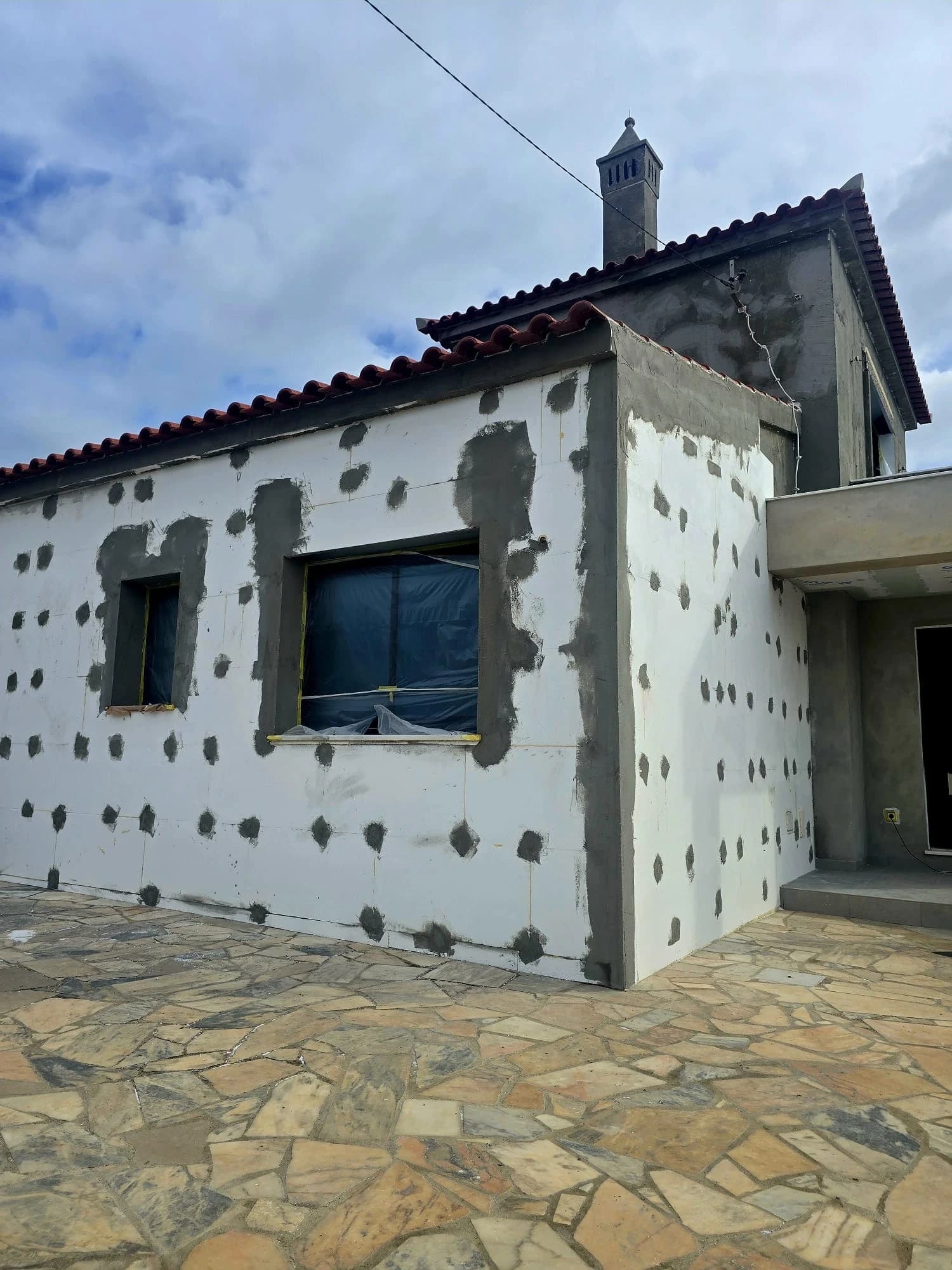
The known disadvantages of Capoto (ETICS) are low impact resistance, a tendency to crack, colour change, susceptibility to algae and fungi on the surface and loss of adhesion between layers. On top of that come a higher initial cost than painting and the need for maintenance.
The list comes from the technical publication on ETICS by LNEC and Instituto Superior Técnico, which notes that these disadvantages have been partly corrected as the systems have evolved. Some, especially those linked to the finishes, still weigh on performance.
| Disadvantage | Why it happens | What prevents it |
|---|---|---|
| Algae and fungi on the surface | The insulated facade stays colder and dries more slowly | Drip edges, a low-absorption finish, biocide |
| Impact damage | The render over the insulation is thin | Reinforced mesh in exposed areas (category I) |
| Cracks | Thin render, missing mesh, unreinforced opening corners | Correct thickness and mesh, reinforced corners |
| Reaction to fire | EPS on its own is combustible (class E) | A system with the classification the building requires |
| Maintenance | The finish ages with rain and sun | Regular inspections and prompt repair |
Why do algae and fungi appear on Capoto?
Because the surface of a well-insulated facade stays colder and takes longer to dry, and the water left there feeds algae and fungi. It is the most common defect: in a study of 146 facades with ETICS in northern and central Portugal, biological growth, colour changes and run-off marks appeared on about half of the sample.
The study and the explanation are in the LNEC and IST publication: the higher the thermal resistance of the system, the colder the outer face and the greater the risk of surface condensation. The stains do not affect thermal performance at first, but they have a big visual impact.
Biocides in the finish help, but the same publication warns that they do not guarantee good long-term results. So it recommends, above all, reducing the water running down the facade:
- Drip edges. Sill profiles and copings with a drip edge throw water away from the wall.
- Downpipes. Properly installed, so that water does not always run down the same spot on the facade.
- Finish. Low water absorption and fast drying of the surface layers.
- Cleaning. If stains appear, wash with low-pressure water and apply a biocide or a new finish with biocide.
Is Capoto vulnerable to impacts?
It is more vulnerable than traditional render: the coating over the insulation is only a few millimetres thick and a hard knock can puncture it. In the most exposed areas, such as the ground floor next to the street, a category I system should be used, which normally requires a second, reinforced glass-fibre mesh.
Systems are classified into three impact resistance categories, I, II and III, with 3 and 10 J impact tests. The LNEC and IST publication states that category I is generally achieved with reinforced mesh, a thicker render or a tougher finish such as ceramic. In ETA 22/0327, every configuration tested, even those with reinforced mesh, was category II.
In the same ETA, the rendering system tested is between 4.3 and 6.8 mm thick. A puncture is not just cosmetic: it leaves the insulation exposed to rain and sun. It should be repaired as soon as it appears.
Why does Capoto crack?
Almost always because of an installation error: render that is too thin, glass-fibre mesh badly placed or missing, or window corners without reinforcement. Cracks let water in, and water that reaches the insulation reduces its thermal resistance.
In a Norwegian study of 61 buildings with ETICS, cited in the LNEC and IST publication, the most common causes included badly installed downpipes, missing or incorrect render reinforcement, very thin render, poorly treated singular points and direct contact between the system and the ground. Cracks also appear at board joints, from shrinkage and differential movement.
That is why the installer matters as much as the system. Our ETICS installers are certified.
Is Capoto safe in a fire?
The most widely used insulation, EPS, is combustible, but what counts is the classification of the complete system, which must meet the requirement for the building. In Portugal, that requirement ranges from C-s3, d0 on low-rise buildings to B-s2, d0 above 28 m.
The webertherm EPS 100 board is class E, but the complete system in ETA 22/0327 achieves class B-s1, d0. The same ETA warns that, as there is no European reference fire scenario for facades, some countries may require additional assessments. The Portuguese values come from the LNEC and IST publication.
Does Capoto need maintenance?
Yes: the finish needs visual inspection, spot repair when there is damage and upkeep of its appearance with products compatible with the system. Defects should be repaired as soon as they appear, because water getting into the system affects thermal performance.
The minimum maintenance is set out in ETA 22/0327. The LNEC and IST publication adds regular inspections to detect micro-cracks and dents, and maintenance plans defined at the design stage. In practice, it is the same care a painted facade needs, with products made for ETICS.
Is Capoto expensive?
The initial cost per m² is higher than conventional exterior painting, because it includes the insulation, the reinforced coat and the finish. On the other hand, well installed, Capoto often saves between 30 and 50 % on heating and cooling costs.
Savings of 30 to 50 % are what we state on our ETICS installation page. The price depends on the type and thickness of the insulation, the area and condition of the facade, the access equipment and the finish. We make a free site visit and a detailed quote, with every component listed.
Are the disadvantages of Capoto worth it?
For most houses, yes, as long as the system is certified and well installed: almost all the disadvantages stem from the workmanship and the details, not the concept. In return, Capoto reduces thermal bridges and indoor condensation without taking floor space from the house.
Before deciding, check three things: the name of the system and its ETA number, the impact resistance category planned for the ground floor and how the sills, opening corners and downpipes will be dealt with.
If you are still getting to know the system, start with the guide what is Capoto (the ETICS system). To see how we work, visit the ETICS installation page.