Blog
What is Capoto (the ETICS system)?
· 5 min read · H.M. Pinturas
What is Capoto? It is the common Portuguese name for ETICS, external wall insulation: insulation boards bonded to the facade and protected by a reinforced render and a finish. In this guide we explain the layers of the system, the insulation materials, the thickness and what to check before hiring someone for the job.
What is Capoto?
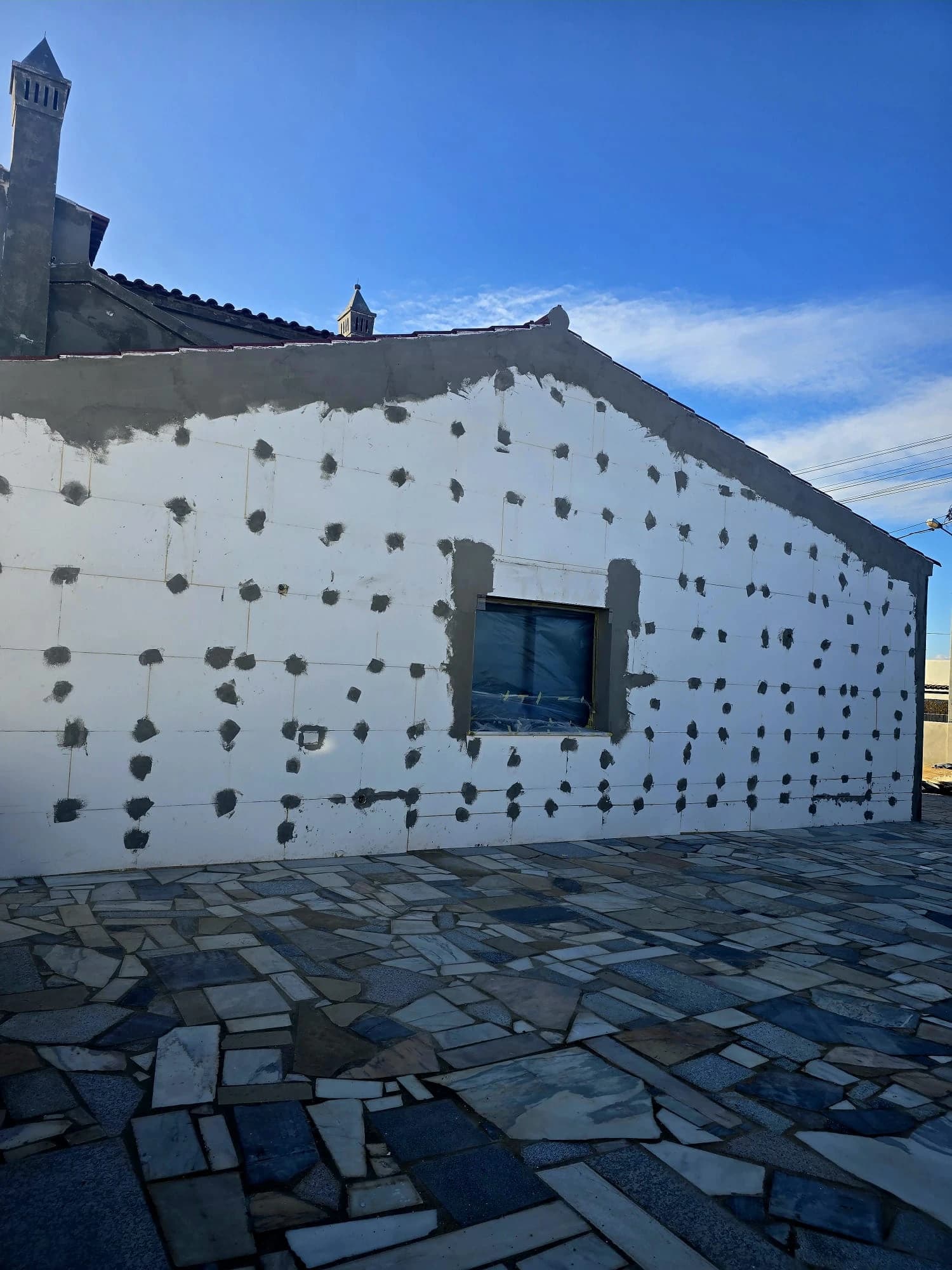
Capoto is an external thermal insulation composite system: a layer of insulation fixed to the wall, a base coat reinforced with glass-fibre mesh and a finishing coat. The insulation wraps the house from the outside, like a coat.
The name comes from the Italian cappotto, meaning coat, as explained in the technical publication on ETICS by LNEC and Instituto Superior Técnico. The same publication describes the system as an increasingly common solution in new construction and facade refurbishment in Portugal.
What does ETICS stand for?
ETICS stands for External Thermal Insulation Composite System. It is the technical name for Capoto, and each system is assessed as a complete kit, from the insulation to the finish.
In Europe, each ETICS system receives a European Technical Assessment (ETA) under document EAD 040083-00-0404. The ETA 22/0327 for the webertherm classic system, issued by Itecons, is an example: it defines the components of the kit, the permitted thicknesses and the performance of each configuration.
That is why Capoto is not put together from loose products of different brands. Before hiring, ask the installer for the name of the system and its ETA number.
What are the layers of Capoto?
From the inside out: the adhesive mortar (with mechanical fixings when the system requires them), the insulation boards, the base coat with glass-fibre mesh and, finally, the primer and the finish. The render is applied directly onto the boards, with no air gap.
| Layer | Role | In the ETA 22/0327 example |
|---|---|---|
| Bonding and fixing | Holds the insulation to the wall | Adhesive mortar, with anchors as supplementary mechanical fixing |
| Thermal insulation | Stops heat passing through the facade | EPS 100 boards, 40 to 150 mm |
| Reinforced base coat | Protects the insulation and resists impacts | Mortar with standard glass-fibre mesh, or double mesh |
| Primer and finish | Gives the colour and protects from rain and sun | Key primer and an acrylic or lime finish |
The LNEC and IST publication adds that the base coat should be applied in two or more layers, each once the previous one has dried, with the mesh between coats. In the areas most exposed to impacts a second, thicker mesh is added, known as reinforced mesh.
Which insulation materials are used in Capoto?
The most common are expanded polystyrene (EPS) and mineral wool, which together account for more than 90 % of the European ETICS market. Extruded polystyrene (XPS) and expanded cork board are also used.
The figures come from the technical publication on ETICS. EPS dominates thanks to its balance of cost and performance: the webertherm EPS 100 board, for example, declares a thermal conductivity of 0.036 W/m·K and reaction to fire class E, which means that, on its own, it is combustible.
What counts is how the complete system behaves, not just the board. In ETA 22/0327, the system with class E EPS achieves class B-s1, d0. In Portugal, according to the same publication, requirements range from C-s3, d0 on low-rise buildings to B-s2, d0 above 28 m, where the insulation must also be B-s2, d0.
How thick is the insulation in Capoto?
In Mediterranean climates such as the Algarve, the insulation is usually between 40 and 100 mm thick. It should be enough for the system to reach a thermal resistance of at least 1.0 m²·K/W.
These are the values in the LNEC and IST publication, which also warns that more thickness does not necessarily mean better performance: durability, behaviour with water and susceptibility to fungi and algae must be weighed up. The right thickness is decided for each house, after seeing the facade.
How is Capoto installed?
The wall must be true, but it does not need to be rendered; then the boards are bonded and fixed, the base coat with mesh is applied in several coats and the job is finished with primer and the final coat. The details, such as window corners, base starts and sills, matter as much as the flat facade.
The technical publication on ETICS identifies workmanship as the critical process for the performance and durability of the system, above all at the singular points of the facade, and recommends skilled labour, well-distributed bonding areas and additional fixings in the most exposed areas and at height.
We carry out ETICS installation with certified installers and with the access equipment each facade needs, from scaffolding to the aerial platform. We reach any height.
What is Capoto for?
It insulates the house from the outside, reducing thermal bridges and the risk of condensation on interior walls. Because it is applied outside, the house stays in use during the work and loses no floor space.
These are the advantages the LNEC and IST publication attributes to ETICS, adding the protection of the walls and structural elements. For our ETICS installation, we state savings of 30 to 50 % on heating and cooling costs when the system is well installed.
Less condensation also means less mould indoors. We explain why in the guide on mould and damp on walls.
How long does Capoto last?
Well installed and maintained, an ETICS system lasts more than 30 years. The European assessment rules assume a reference service life of at least 25 years, provided there is normal, regular maintenance.
ETA 22/0327 defines that minimum maintenance: visual inspection, spot repair of damaged areas and upkeep of the appearance with products compatible with the system. Capoto also has limits, such as impact resistance and a tendency to grow algae on the surface, which we explain in the guide on the disadvantages of Capoto.
A lifespan of more than 30 years is what we state for our ETICS installation, and all our work has a 5-year guarantee against application or material defects.